
Search

Check out our top tips for travelling with an ear infection so that the kids can fly safely and hit the pool in no time.

Researchers have found kids who experience repeat ear infections in infancy have a much higher risk of ongoing problems with ear infections in later childhood
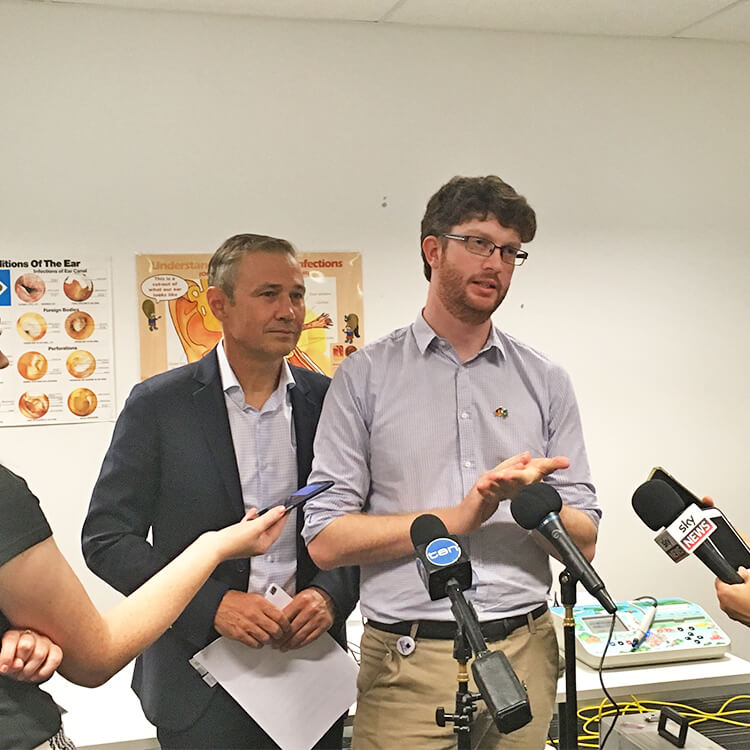
Wait times for Aboriginal children suffering ear infections could be reduced to less than four weeks thanks to a new The Kids Research Institute Australia research project
The introduction of universal newborn hearing screening has allowed for early identification and diagnosis of children with severe-profound hearing loss. This study aims to provide the first Western Australian perspective on the surgical feasibility and safety of cochlear implantation before 12 months of age.
Otitis media with effusion (OME) affects hearing, speech development, and quality of life (QoL) in children. The 'Blow, Breathe, Cough' (BBC) intervention promotes nasal, respiratory, and middle ear clearance through nose blowing, deep breathing, coughing, and hand hygiene. It shows promise in resolving OME but lacks randomized-controlled trial (RCT) evaluation. This paper presents a RCT protocol evaluating BBC's effect on OME resolution, hearing, speech, and QoL in children aged two to seven years.
In remote communities of northern Australia, First Nations children with hearing loss are disproportionately at risk of poor school readiness and performance compared to their peers with no hearing loss. The aim of this trial is to prevent early childhood persisting otitis media (OM), associated hearing loss and developmental delay.
Children in Papua New Guinea (PNG) are at high risk of pneumococcal infections. We investigated pneumococcal carriage rates, serotype distribution, and antimicrobial susceptibility in PNG children after vaccination with 10-valent or 13-valent pneumococcal conjugate vaccines (PCV10; PCV13).
Melinda Edmunds BSc Program Manager, Ear and Hearing Health Melinda.Edmunds@thekids.org.au Program Manager Melinda is the Program Manager of the Ear
Chronic suppurative otitis media (CSOM), sometimes referred to as chronic otitis media, is a chronic inflammation and often polymicrobial infection (involving more than one micro-organism) of the middle ear and mastoid cavity, characterised by ear discharge (otorrhoea) through a perforated tympanic membrane.
Chronic suppurative otitis media (CSOM) is a leading global cause of potentially preventable hearing loss in children and adults, associated with socioeconomic deprivation. There is an absence of consensus on the definition of CSOM, which complicates efforts for prevention, treatment, and monitoring.